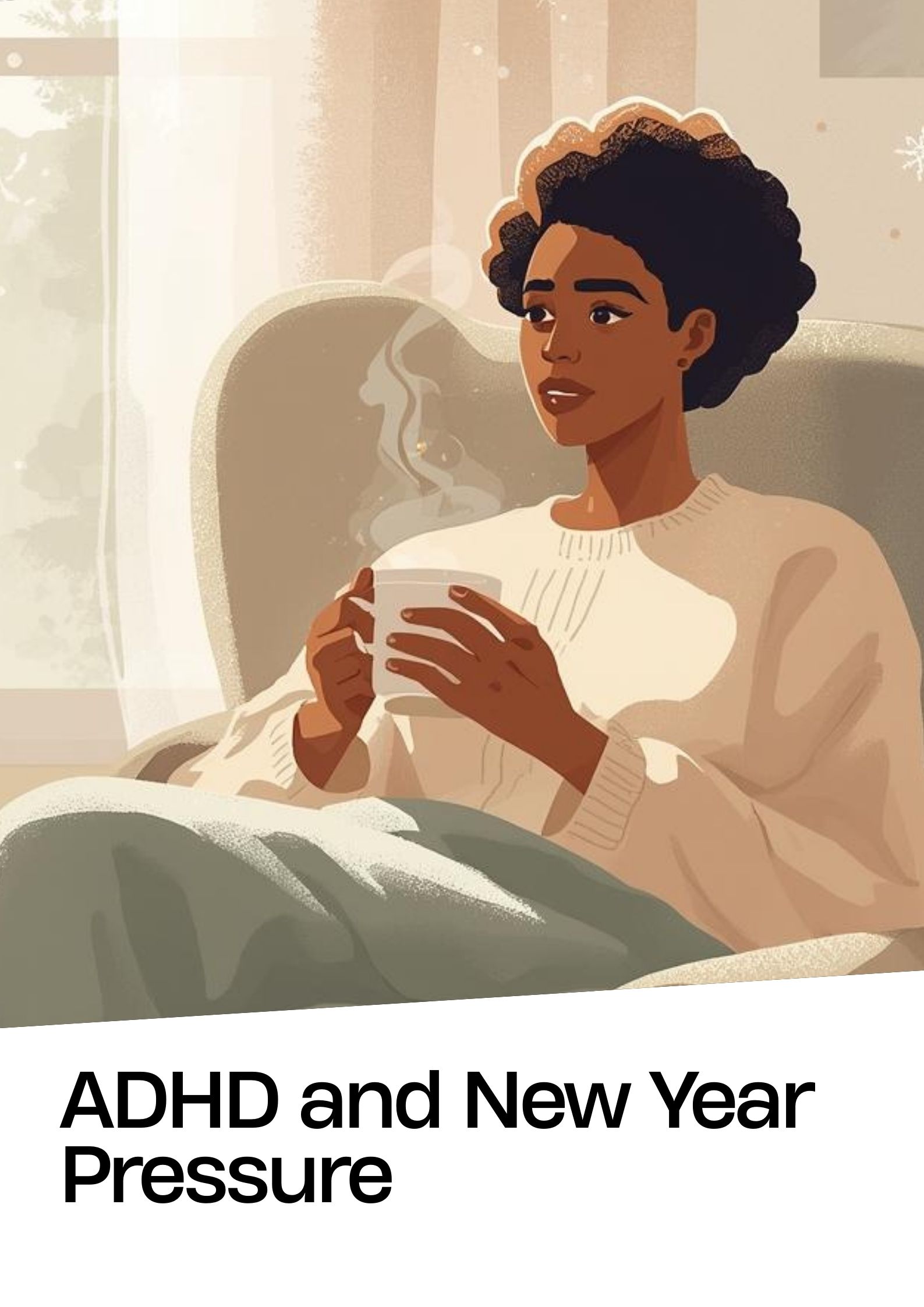
The start of a new year often arrives with a quiet expectation to change. To set goals, build routines, and become more organised, focused, and consistent. For many people, ADHD and New Year pressure go hand in hand, making this time of year feel less like a fresh start and more like a demand to become someone else entirely.
Our culture tends to treat growth as something neat and predictable. Progress is supposed to be linear, visible, and measurable. But ADHD nervous systems are not built for rigid timelines or one-size-fits-all systems. Attention shifts. Energy fluctuates. Motivation arrives in waves. None of this is a failure—it is simply how many nervous systems function.
If January brings exhaustion instead of excitement, you are not doing anything wrong. Burnout does not reset itself because the calendar flips. Neither do grief, overwhelm, chronic stress, or the cumulative weight of trying to keep up in environments that were never designed with neurodivergent people in mind.
That familiar feeling of being “behind” often comes from external expectations, not from a lack of effort or care. Many people with ADHD are working incredibly hard just to maintain daily functioning. The problem is not motivation—it’s mismatch.
ADHD brains tend to thrive with interest, novelty, connection, and flexibility. Change is often relational, experiential, and nonlinear, rather than driven by discipline alone. Growth unfolds through curiosity, trial and error, and returning to yourself again and again—not through pressure or self-criticism.
What often gets labelled as “inconsistency” is actually adaptation. Resting when your nervous system needs it. Shifting strategies when something stops working. Letting go of routines that look good on paper but cost too much internally.
Instead of asking, What should I be fixing this year?
You might gently ask, What helps me feel more supported and regulated?
Instead of, Why can’t I stay consistent?
You might ask, What does consistency look like for me, right now?
The new year does not have to be about reinvention. It can be a soft continuation. A place where you keep going—at a pace that honours your capacity, your needs, and the way your brain naturally works.
You do not need to justify rest. You do not need to earn gentleness. And you do not need to prove growth through productivity, hustle, or perfection.
Wherever you find yourself as this year begins—hopeful, tired, uncertain, or simply surviving—you are not behind. You are adapting. And that matters.
This piece is for general informational purposes and is not a substitute for mental health care. If you’re struggling, support from a qualified professional can help.